Tradingviewdownload price alerts monitor crypto price conditions once or repeatedly
Last updated
Tradingviewdownload price alerts use TradingView’s Only Once or Every Time setting to monitor chosen crypto price levels. For a single-symbol alert, Only Once stops monitoring after its first trigger; Every Time permits later qualifying triggers while the rule remains active. The operator determines whether a crossing direction or an above-or-below price condition qualifies.
The frequency setting does not select the market or change the price rule. Match the chosen crypto symbol with its operator, threshold and notification method. Expiration schedules when the alert stops monitoring.
Crossing direction filters qualifying price moves
Crossing tests whether the price reaches or passes a chosen level, so directional variants filter which movements can trigger the alert. An operator supplies the comparison rule for the selected price series.
Crossing up requires the price to reach or pass the level from below; Crossing down requires it to reach or pass from above. An upward-crossing rule needs an upward crossing even when the price already sits above its threshold at creation. Starting above that level does not establish the required movement.
Greater than and Less than test the price’s position relative to the threshold. Greater than requires a price at least one minimum tick above the threshold; Less than requires one at least one tick below it. A minimum tick is the symbol’s smallest permitted price increment. Reaching the boundary and moving beyond it therefore answer different conditions. A crossing describes a transition; an above-or-below test describes a price state.
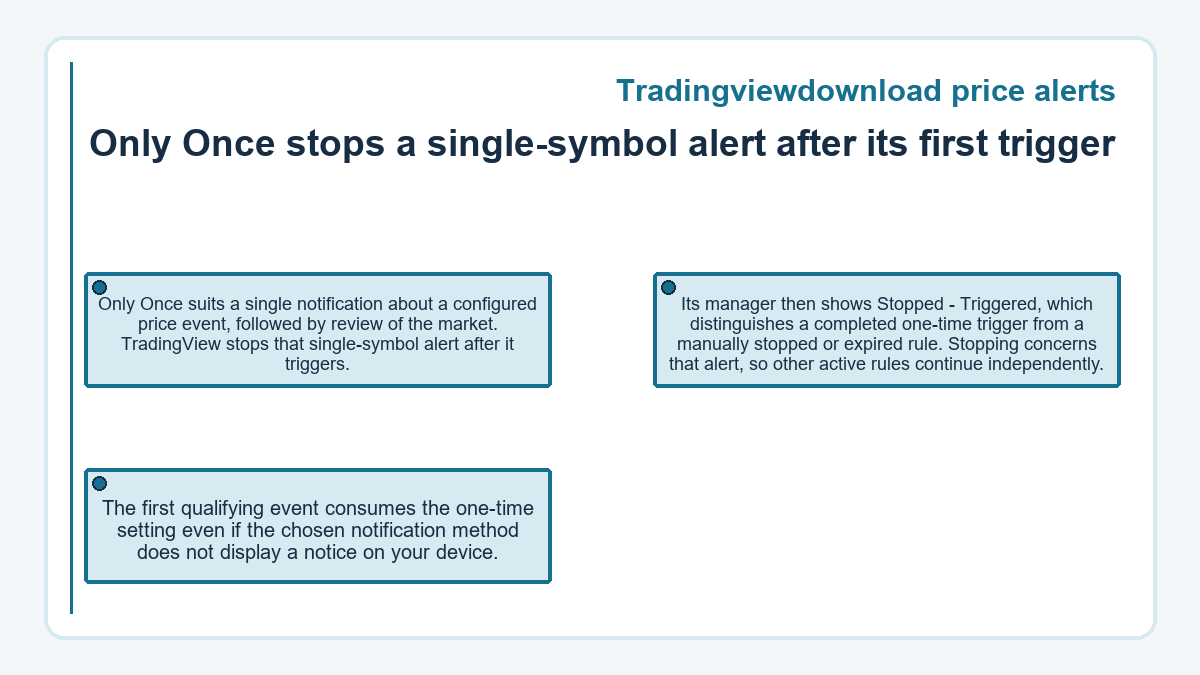
Only Once stops a single-symbol alert after its first trigger
Only Once suits a single notification about a configured price event, followed by review of the market. TradingView stops that single-symbol alert after it triggers. Its manager then shows Stopped - Triggered, which distinguishes a completed one-time trigger from a manually stopped or expired rule. Stopping concerns that alert, so other active rules continue independently. The first qualifying event consumes the one-time setting even if the chosen notification method does not display a notice on your device.
Repeat triggers depend on the operator and alert type
Every Time checks the condition each minute and triggers when it qualifies while the alert remains active. With a Crossing up operator, another qualifying upward crossing differs from the price simply remaining above the level. Greater than tests an above-threshold state, so recurring triggers under that operator need not describe fresh crossings.
Recurring monitoring can also use Channel or Moving operators, which TradingView classifies as technical alerts under a separate active-alert limit. Entering channel and Exiting channel detect movement across the boundaries of a configured range. Inside channel and Outside channel test where the price lies relative to that range. Moving up and Moving down measure an amount of change over a specified number of bars; their percentage versions express that change proportionally. Those movement conditions include a time window, unlike a fixed absolute price threshold.
A one-time upward crossing produces a visible stopped state
In this hypothetical example, a selected crypto symbol trades below a threshold denoted by L, you want one upward-crossing notice and the chosen expiration lies in the future. The symbol and threshold stay unchanged during the check.
Create a Price alert for that symbol using Crossing up, set the chosen price level as the threshold and choose Only Once. Saving establishes the configured rule. An Active status in the Alerts Manager shows the alert is running; it does not show the price has crossed the threshold.
Suppose the monitored price later crosses upward through L and the alert triggers before expiration. The Alerts Log contains the event, and the manager shows Stopped - Triggered. Together, those observations establish a completed one-time trigger. A later crossing cannot retrigger that stopped rule without reactivation. The log entry describes the alert event, not what the crypto price does afterward.
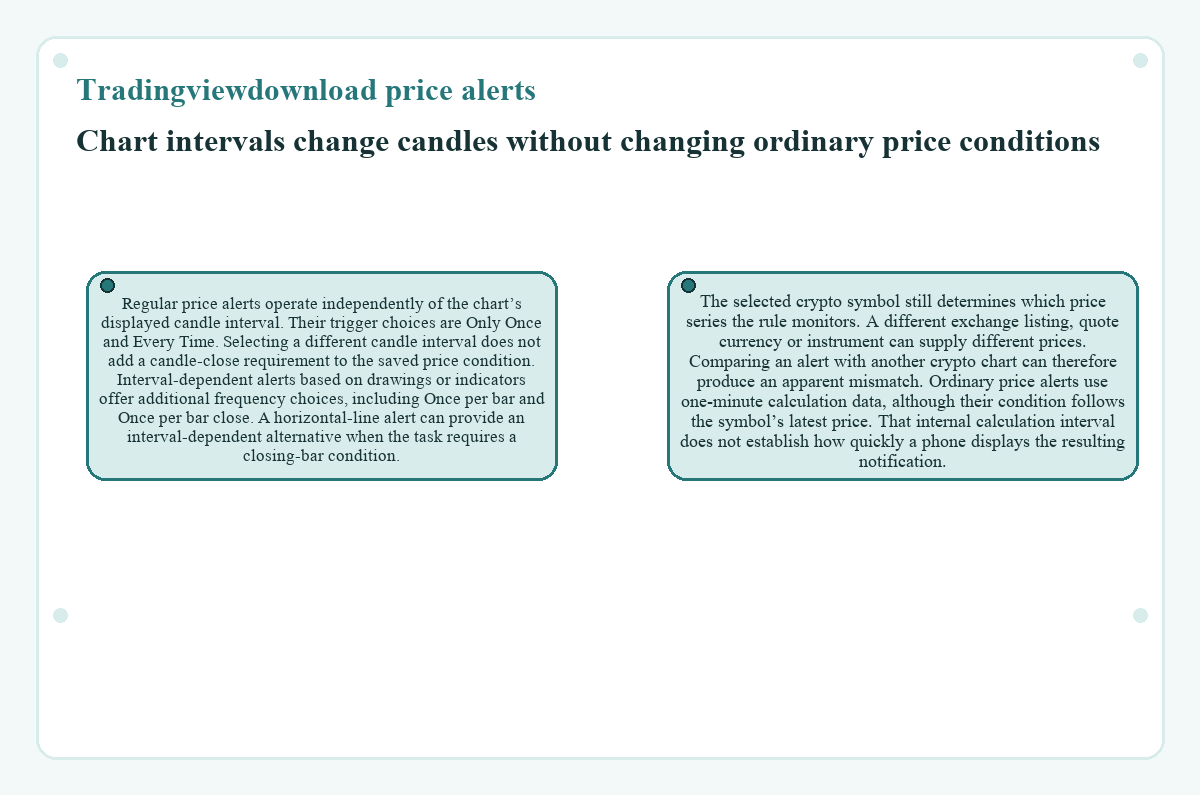
Chart intervals change candles without changing ordinary price conditions
Regular price alerts operate independently of the chart’s displayed candle interval. Their trigger choices are Only Once and Every Time. Selecting a different candle interval does not add a candle-close requirement to the saved price condition. Interval-dependent alerts based on drawings or indicators offer additional frequency choices, including Once per bar and Once per bar close. A horizontal-line alert can provide an interval-dependent alternative when the task requires a closing-bar condition.
The selected crypto symbol still determines which price series the rule monitors. A different exchange listing, quote currency or instrument can supply different prices. Comparing an alert with another crypto chart can therefore produce an apparent mismatch. Ordinary price alerts use one-minute calculation data, although their condition follows the symbol’s latest price. That internal calculation interval does not establish how quickly a phone displays the resulting notification.
Notification settings determine where a triggered alert appears
Alert delivery options include app notifications, pop-ups, email and sound. Phone delivery requires the TradingView mobile app, sign-in to the account holding the alert, device permission for push notifications and Notify in App enabled for that alert. Browser pop-ups require notification permission. On Android, background restrictions can also affect receipt. A missing phone notice alone does not establish that the price condition failed.
Send Email uses the address in the account profile, while Send plain text can use an alternative email address. A webhook sends the alert message to an external receiver, and its Webhook status appears in the alert log. Delivery can fail independently of the price trigger. An ordinary price notification does not submit a trading order; external automation responding to a webhook has its own execution state. Keep login credentials out of webhook messages.
Expiration and stopping reasons bound continued monitoring
Expiration defines the scheduled end of monitoring, independently of whether the alert uses a one-time or repeating trigger. Standard alerts have a maximum lifetime of two months, with Basic limited to one month. Premium and Ultimate support the Open-ended option for eligible alerts, removing scheduled expiration. Watchlist alerts cannot use that option. Open-ended monitoring still has other stopping conditions, so choosing it does not establish permanent activity.
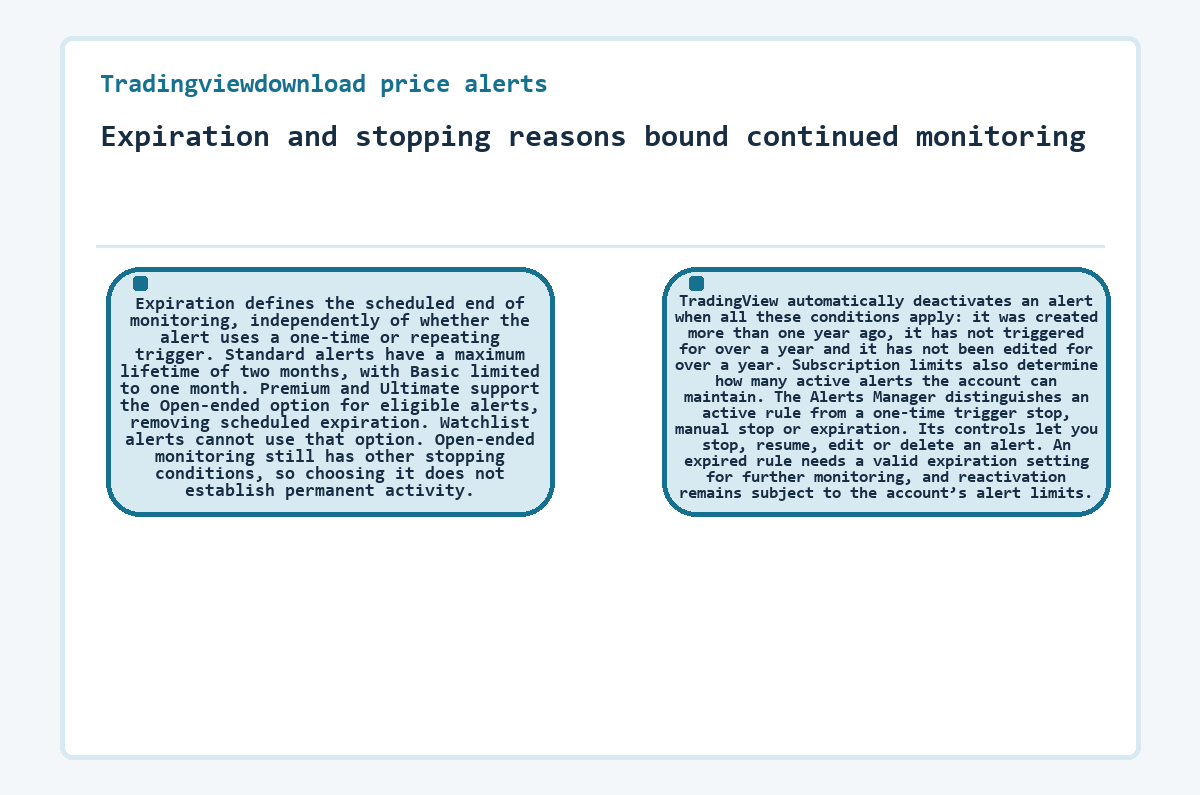
TradingView automatically deactivates an alert when all these conditions apply: it was created more than one year ago, it has not triggered for over a year and it has not been edited for over a year. Subscription limits also determine how many active alerts the account can maintain.
The Alerts Manager distinguishes an active rule from a one-time trigger stop, manual stop or expiration. Its controls let you stop, resume, edit or delete an alert. An expired rule needs a valid expiration setting for further monitoring, and reactivation remains subject to the account’s alert limits.
Still wondering about Tradingviewdownload price alerts?
What market details can a crypto price-alert message include?
A crypto price-alert message can include the symbol, exchange and price through dynamic placeholders. TradingView substitutes values for {{ticker}}, {{exchange}} and {{close}} when the alert triggers. The close placeholder refers to the corresponding alert bar’s value, which gives the message a price context without establishing a trading fill.
Does a crypto price-alert preset save the exact threshold?
A crypto price-alert preset does not save the threshold value field. It can preserve the operator, trigger frequency and selected notification preferences, excluding webhook URLs. Enter the numeric level for each new alert.
How can I export the history of triggered crypto price alerts?
The Alerts Log can export retained crypto price-alert history to a CSV file through its Options menu. Daily cleanup deletes events older than 30 days or beyond the latest 100 triggers per alert, so export before deletion to preserve older records. The export concerns alert events, so it provides trigger history rather than a list of trading executions or a backup of active alert rules.
When does a plan downgrade stop recurring crypto price alerts?
TradingView stops all active alerts when the account switches to a lower-tier subscription. Stopped crypto price alerts can restart within the new plan’s limits. Their previous Every Time selection does not prevent this subscription-related stop.
Is two-factor authentication necessary for crypto price-alert webhooks?
TradingView requires two-factor authentication before enabling webhook alerts, including webhooks attached to crypto price conditions. This prerequisite concerns sending the alert message to an external receiver. It applies independently of choosing Only Once or Every Time.
Can one alert monitor several crypto symbols in a watchlist?
A watchlist alert requires Premium or Ultimate and evaluates its shared condition independently for each symbol, including crypto symbols. Adding a symbol extends monitoring to it, while removing one ends monitoring for that symbol. This differs from an alert attached to a single symbol. Watchlist alerts cannot use the Open-ended expiration option.