Tradingviewdownload enables crypto limit-order practice with virtual funds through TradingView Paper Trading
Last updated
Tradingviewdownload lets you practice crypto limit orders in TradingView by connecting Supercharts to a Paper Trading account. The simulator uses virtual funds, so placing an order does not purchase cryptocurrency on an exchange. A limit order sets the highest purchase price or lowest sale price you accept, together with a quantity. Practice centers on choosing a tradable crypto symbol, entering those conditions and distinguishing a pending instruction from a simulated fill.
Paper Trading requires sufficient margin at execution, even when a crypto limit order already meets its price condition.
Paper Trading connection and symbol selection
Paper Trading connects to the chart workspace as a simulated trading account, with crypto among its supported asset classes. In Supercharts, open Trade, choose Paper Trading and select Connect. Confirm the selected trading account before preparing an order. A connection to a real broker represents a different execution environment, with its own supported instruments and order types. The installed application provides the workspace; the account connection determines where the order instruction goes.
A chartable symbol may still be unavailable for simulation. TradingView excludes synthetic symbols it calculates, identifiable by a purple market-status label. Symbol Search displays the instrument type beside the data feed name. Establish that the selected crypto instrument supports Paper Trading before entering its order parameters.
Limit-order parameters and their constraints
The Paper Trading order ticket combines a chosen price with quantity, duration and optional exit settings. Selecting Limit makes the price an execution condition. Entry fields support an absolute price or a tick offset from the relevant quote. Quantity fields also support risk-based sizing using a stop-loss level, so the selected input method changes how the ticket derives the order size.
| Parameter | Setting or supported value | Execution condition or limit |
|---|---|---|
| Order type | Limit | Requires a price and quantity; a fill is not assured |
| Order side | Buy or sell | Buy price is a ceiling; sell price is a floor |
| Entry price | Absolute price or quote-relative tick offset | Offsets reference the ask for buys and bid for sells |
| Quantity input | Units, currency amount or balance percentage | Additional risk-based modes depend on a stop-loss level |
| Time in force | Order duration selected in the ticket | Paper Trading does not offer Good ’Til Cancelled orders; it cancels unfilled orders when their selected duration expires |
| Multiple exit levels | Up to 4 paired take-profit and stop-loss levels | Exit quantity beyond 100% of the main order’s quantity does not execute |
| The entry order and its exits have separate price conditions and quantity settings. | ||
Buy ceilings and sell floors
Limit prices define acceptable execution prices in opposite directions for purchases and sales. A market order seeks execution at the available market price. A stop-market order waits for a trigger, then becomes a market order. Those differences matter when choosing whether practice should emphasize a price boundary or entry after a particular market move.
The purchase ceiling
A buy limit specifies the maximum purchase price. Lower prices also satisfy that price boundary, subject to the order’s remaining execution conditions.
A limit below the ask
A buy limit below the available ask requires a more favorable selling quote before its price condition holds. Waiting is consistent with the instruction; changing the limit changes the acceptable purchase price.
A price already available
A buy limit at or above an available ask can already satisfy its price condition. Limit does not automatically mean delayed execution. A stop entry expresses a different instruction when the intended condition involves reaching a trigger.
The sale floor
A sell limit specifies the minimum sale price. Higher prices satisfy that boundary.
Chart order submission and edits
Chart trading allows order preparation and modification directly on Supercharts, synchronized with the order ticket. A projected order displays editable price, quantity and bracket settings before submission. The confirmation button sends the prepared instruction; seeing a projection on the chart alone does not establish an active order.
The confirmation mode governs how chart edits apply. With confirmation enabled, Confirm applies changes and Discard returns to the original state before editing began. Without confirmation, supported actions such as dragging an order apply changes immediately. Deselecting an order does not cancel its editing or projection mode.
Order records distinguish submission from execution. Orders displays the account’s order instructions, while Positions displays active exposure. History records filled, rejected and canceled orders; Trading journal supplies textual entries and their times.
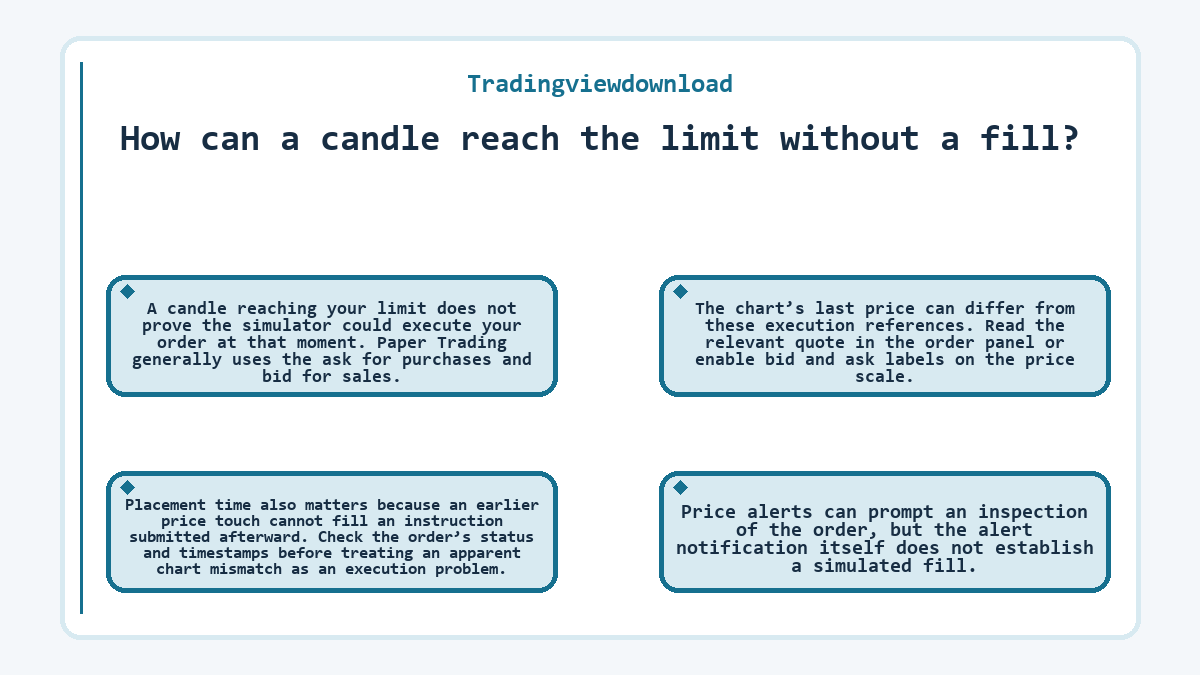
How can a candle reach the limit without a fill?
A candle reaching your limit does not prove the simulator could execute your order at that moment. Paper Trading generally uses the ask for purchases and bid for sales. The chart’s last price can differ from these execution references. Read the relevant quote in the order panel or enable bid and ask labels on the price scale.
Placement time also matters because an earlier price touch cannot fill an instruction submitted afterward. Check the order’s status and timestamps before treating an apparent chart mismatch as an execution problem. Price alerts can prompt an inspection of the order, but the alert notification itself does not establish a simulated fill.
Margin at the moment of execution
Paper Trading will not execute an order if its required margin exceeds the available margin at execution. The order ticket distinguishes trade value, which describes total exposure, from available margin, which describes funds available as collateral. Other open positions can affect the amount available for another order. An acceptable limit price therefore does not establish that the account can support the requested size.
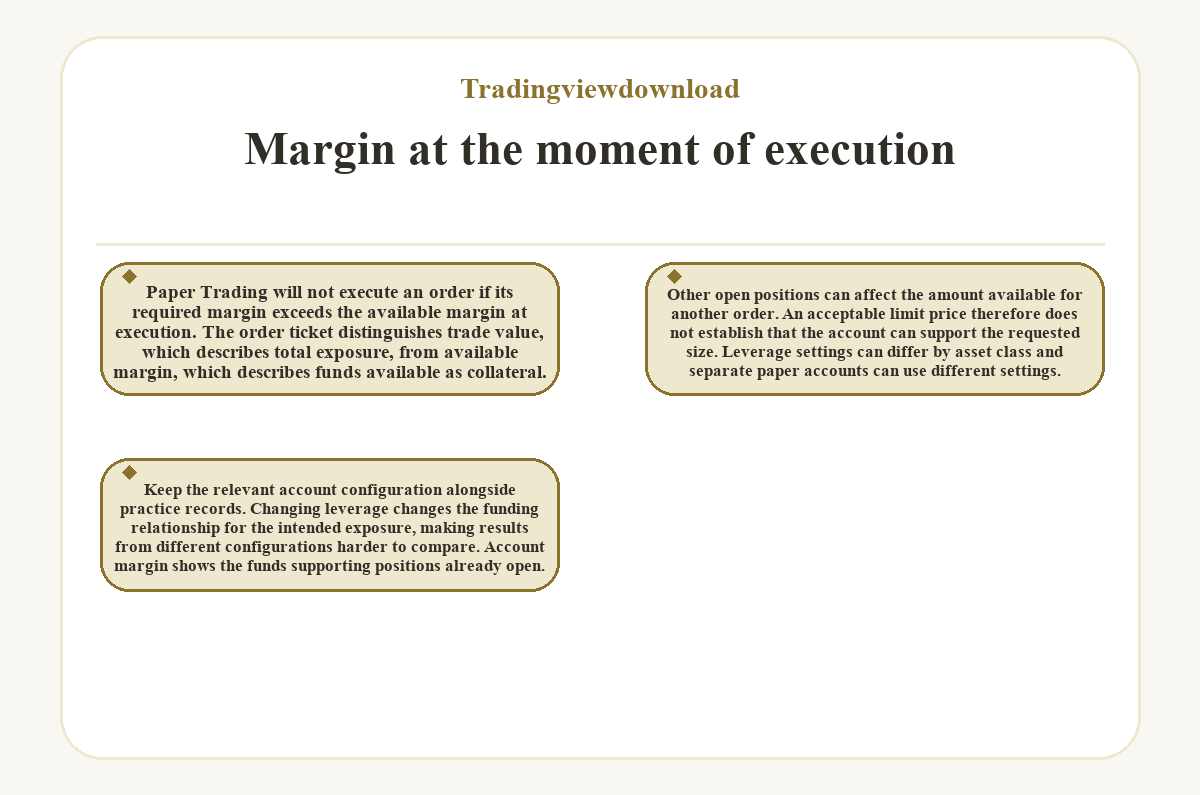
Leverage settings can differ by asset class and separate paper accounts can use different settings. Keep the relevant account configuration alongside practice records. Changing leverage changes the funding relationship for the intended exposure, making results from different configurations harder to compare. Account margin shows the funds supporting positions already open.
Take-profit and stop-loss quantities
Exit settings attach take-profit and stop-loss instructions to a proposed order or an existing position. A stop-market exit converts into a market order after its trigger, so its trigger price does not guarantee the eventual execution price.
Paired levels in Paper Trading
Paper Trading supports up to 4 multiple exit levels, each pairing a take-profit with a stop-loss. This pairing differs from regular bracket settings, which can use one or both exits. The Add level control opens the multiple-exit configuration. Each level has its own quantity and separate take-profit and stop-loss prices, allowing different portions of a position to have different exit conditions. Executing either exit cancels the other in that pair; deleting either placed exit deletes both.
Quantity coverage
The multiple-exit dialog shows how much of the main order’s quantity the levels cover. Each executed level closes its assigned portion of the position. Paper Trading does not execute the portion of exit quantity exceeding 100% of the main order’s quantity. Check coverage after changing size so the configured exits still describe the intended allocation.
Practice settings between sessions
Commission settings change the simulated cost of entering and closing trades. The account deducts configured commissions from virtual funds. For instruments outside futures and options, the Other commission section supports fixed or percentage-based charges. Futures and options also support a per-contract method, calculated from contract quantity. Choose the method matching the instrument being practiced; a fee method for contracts does not describe every crypto instrument. A result with commissions disabled omits that configured trading cost.
Separate Paper Trading accounts allow different approaches to retain their own account settings. Record the currency, leverage and commission configuration before comparing sessions. Unrealized profit and loss describes open positions; realized profit and loss describes closed exposure. A higher account equity can include unrealized gains, so it does not necessarily represent the outcome of completed trades.
Bar Replay and live-exchange fill limits
Bar Replay changes the chart’s historical playback without moving the Paper Trading account into that historical market. Paper Trading orders use real-time data even when Bar Replay displays historical candles. Quotes in the trading panel also continue to represent real-time data. Keep this distinction visible when reviewing a limit beside an older candle: its apparent position on the replay chart does not explain the account’s live execution conditions.
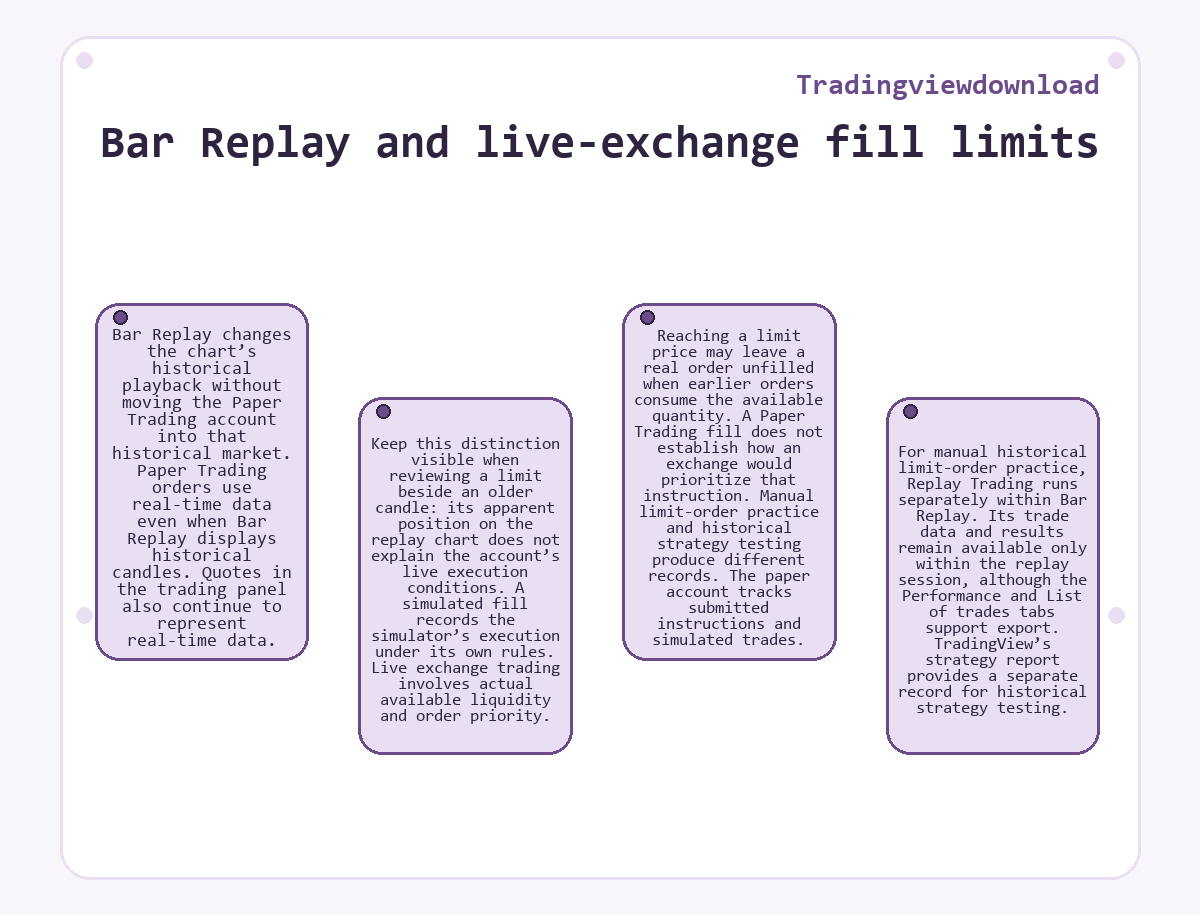
A simulated fill records the simulator’s execution under its own rules. Live exchange trading involves actual available liquidity and order priority. Reaching a limit price may leave a real order unfilled when earlier orders consume the available quantity. A Paper Trading fill does not establish how an exchange would prioritize that instruction.
Manual limit-order practice and historical strategy testing produce different records. The paper account tracks submitted instructions and simulated trades. For manual historical limit-order practice, Replay Trading runs separately within Bar Replay. Its trade data and results remain available only within the replay session, although the Performance and List of trades tabs support export. TradingView’s strategy report provides a separate record for historical strategy testing.
Tradingviewdownload: reader questions
-
Can I save a crypto limit-order setup for repeated Paper Trading sessions?
- TradingView order presets can save limit-order settings for reuse. Presets support order type, relative entry price, bracket settings and validity period. Pending-order presets use tick offsets from the buy or sell quote. Review the resulting price and selected side before submitting a reused setup.
-
How do I export my simulated crypto limit-order history?
- In the Paper Trading account manager, click the broker name to open its menu and export your trading data as a CSV file. Use the CSV to review simulated crypto limit-order activity outside the chart workspace.
-
Does changing the account currency delete my crypto limit-order practice history?
- Changing an existing Paper Trading account’s currency through a reset deletes its transaction history, active orders and open positions. Creating a new account with another available currency avoids resetting the existing account. The selected account currency governs its transaction, profit and commission calculations.
-
Will several crypto limit-order fills create separate positions for the same symbol?
- Paper Trading maintains at most one combined position per symbol, so multiple fills do not create separately managed positions for that symbol. The History tab retains individual order records. Read those records when examining separate entries and use the position row when examining the account’s combined exposure.
-
What does contract expiration do to pending crypto futures limit orders?
- Paper Trading cancels active orders for expired futures contracts. It also closes expiring positions using the final settlement price, with the last daily bar’s closing price serving as a fallback when settlement data is unavailable. Perpetual and continuous futures do not undergo this settlement process.